Data Projects
Data Project 001: Determine the Percentage of Each Numerical Digit From 0 to 9 in Various Lengths of the Fibonacci Sequence
The Fibonacci Sequence is well known for being a numerical sequence that starts with the numbers 0 and 1, and continues to grow based on a simple rule. Each number following 0 and 1 in the sequence is calculated by the sum of the previous two numbers. For example, the third number in the Fibonacci Sequence is 1 because 0 (1st sequence number) + 1 (2nd sequence number) = 1.
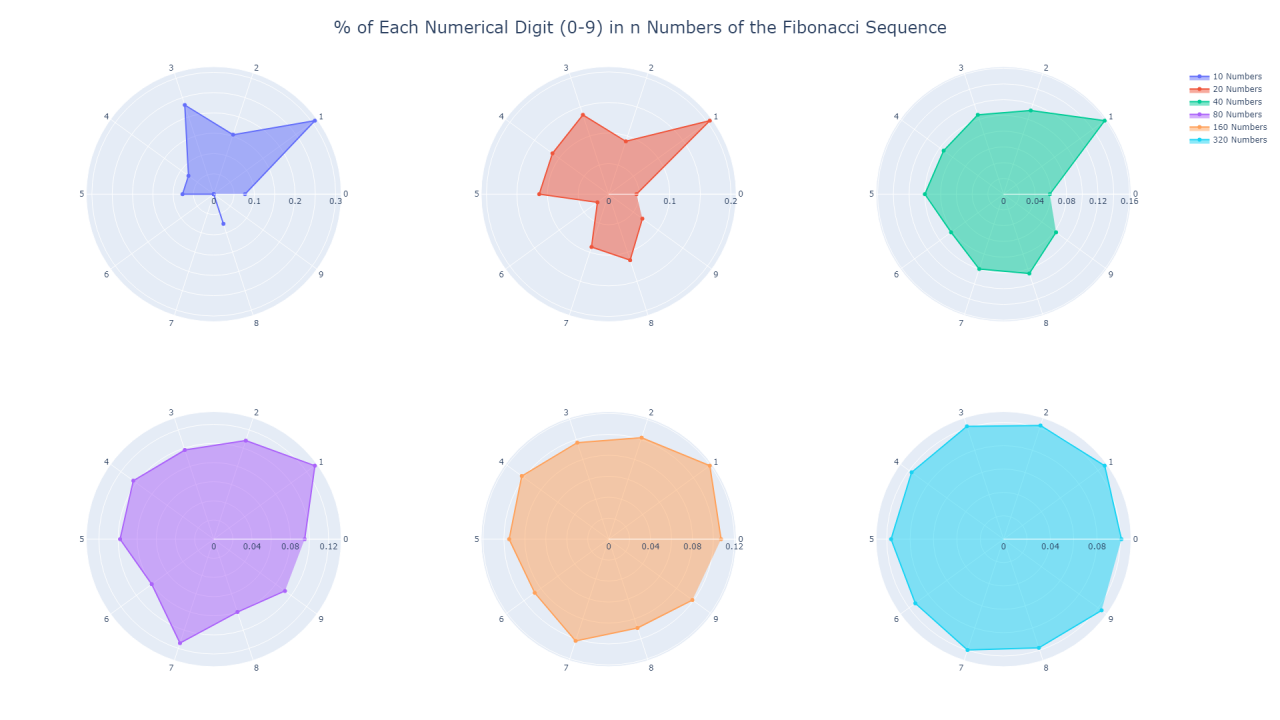
As well known as the Fibonacci sequence is, especially in nature, this data project investigates the question of how each digit in the series is represented as the sequence grows larger and larger. To tackle the task, some simple Python functions were written, and the Plotly Python library was utilized to achieve the following results.
The radar charts below show how the percentage of each digit in the sequence changes when more and more numbers are added to the series. For example, the first chart (top left) represents the first 10 numbers in the sequence –> [0, 1, 1, 2, 3, 5, 8, 13, 21, 34], and holds 13 total digits. This is why digit 1 has the largest percentage on the chart, as 1 makes up 4/13 (30.8%) of the total digits in that particular series. As more and more numbers are added to the sequence, a pattern eventually appears. When the sequence becomes large enough, the percentages of each digit in the series become roughly the same (~10%). Further testing shows that adding more numbers to the sequence (ex. 640, 1280, …) did not change this trend, and that each digit retained ~10% of the total distribution of digits, even if their individual percentages were not exactly the same as other high-numbered sequences.
Stay tuned, as more data projects and curiosities will be explored in the future.